Sacred Geometry Explained: The Flower of Life, Metatron's Cube and the Blueprint of Creation
The Monad: One Circle and the Birth of Form
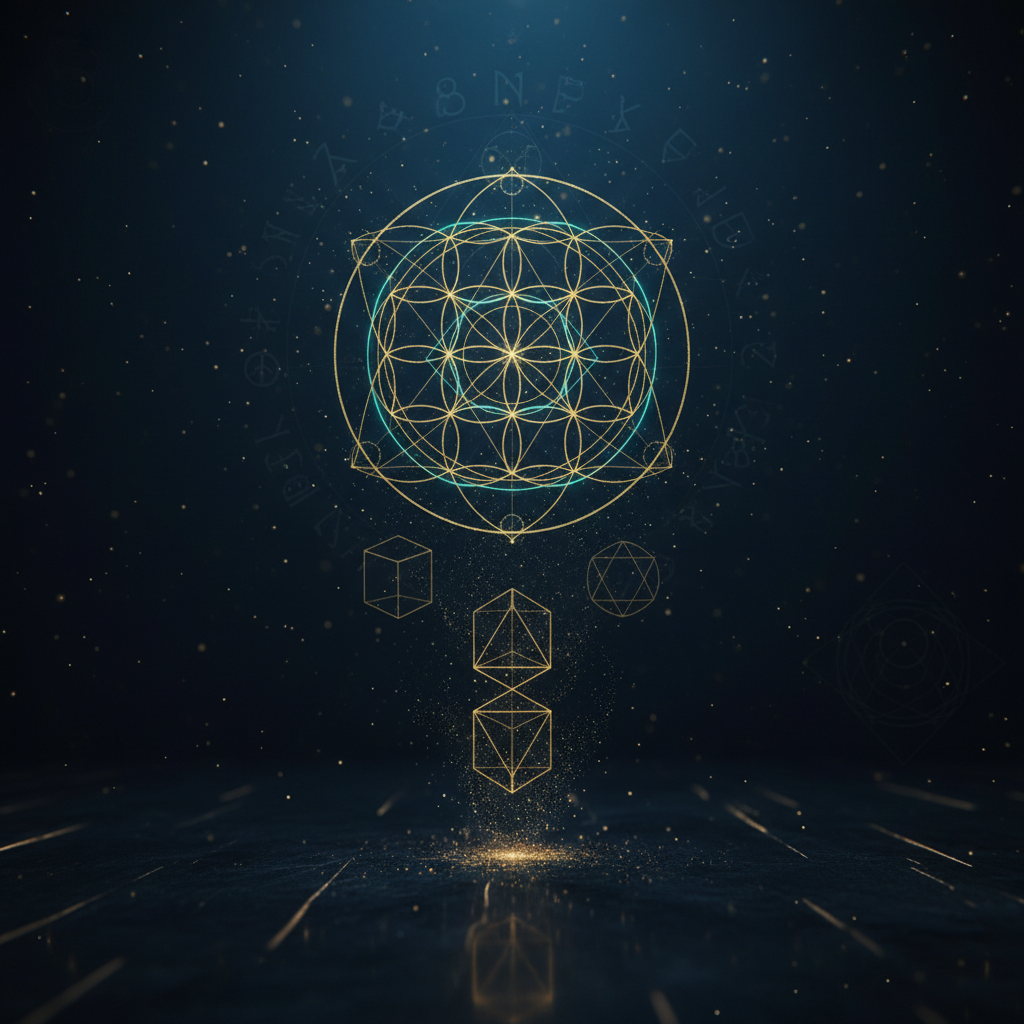
The tradition recognizes a hierarchy of figures, and every one of them is descended from the circle. Schneider draws the lineage explicitly: "Nature's patterns are based on the mathematics of three-dimensional space. In essence, nature's creating process yields its fruit by giving birth to volume. The archetypal field where the patterns first appear is a sphere, a Monad." The word monad — literally "oneness" — is the technical name for this point of departure. A point in space, extended equally in all directions, becomes a sphere; a sphere cut through its center becomes a circle. All of it is one act: the assertion of a center.
That assertion carries a meaning far older than geometry. The Heliopolitan creation myth of Egypt, which Robert Lawlor retells in Sacred Geometry: Philosophy and Practice, imagines the beginning as Nun, the Cosmic Ocean — "pure, undifferentiated" primordial water. From the surface of Nun a mound of earth arises (the benben), and upon it the first god Atum comes into being, and from Atum the whole pantheon and world unfold. The geometry of the story is exact: the point of the mound is the monad, the cosmic ocean that surrounds it is the undifferentiated field the circle inscribes. Creation, in both the myth and the compass, is the same operation — a center asserting itself out of a formless surround.
Why does the circle carry this founding role? Because it is the only figure defined by a single center, and therefore the only figure whose every point stands at equal distance from the origin. It is the perfect image of equality radiating in all directions — what Schneider means by "the Monad's principle of equality in all directions." Every later shape is a violation of the circle's perfect equality, a decision to privilege certain directions over others. Sacred geometry, in this reading, is the patient record of those decisions.
The Seed of Life: Drawing the First Family of Circles
Now we draw. Set the compass at any opening; scribe a circle. The writing has begun.
Take the compass, keep its opening unchanged — this is the crucial constraint — and place the point of the stylus anywhere on the first circle's circumference. Swing a second circle. Now lift the compass again, again without changing its size, and put its point at one of the two places where the second circle crosses the first. Swing a third. Continue, working outward, always resting the center of the new circle on the circumference of a circle already drawn, and after seven circles you will have produced the Seed of Life: seven circles arranged around a central one, their centers at the vertices of a regular hexagon, each circle overlapping its neighbors with perfect evenness.
The first moment of this construction rewards close attention, because it already contains the mystery. When you place the compass point on the first circle's circumference, that second center is "actually an emanation of the original circle," as Schneider notes in A Beginner's Guide to Constructing the Universe, "since it resides on its circumference." The second circle is not an addition from outside; it is generated by the first, born from the first's own edge. This is the tradition's definition of creation: not the imposition of new material from without, but the unfolding of latent content from within. The Greeks, Schneider observes, saw the cosmos "unfold in the same sequence as a plant grows: seed, stem, leaf, and fruit." Geometry does the identical thing — every step is an outgrowth of the last, nothing imported, everything grown.
Continue the pattern a few circles further and the network expands into the full Flower of Life: a lattice of nineteen interlocking circles arranged in a hexagonal flower formation, each circumference passing through the center of its neighbors. This is the emblem that adorns temples across the world — carved in Egypt, painted in China, incised in Turkey — and the claim bundled into it is audacious: from this pattern alone, nearly every other sacred shape can be derived. It is the universal ancestor of the symbol family. Drunvalo Melchizedek, who treats the Flower of Life as the master key of his teaching across both volumes of The Ancient Secret of the Flower of Life, demonstrates again and again that the grid of circles and their centers contains, folded within itself, the entire alphabet of forms we are about to unpack.
The Vesica Piscis: Where Two Circles Give Birth
Before the Flower gains its fruit, pause at the smallest gap its construction produces. The moment two equal circles overlap, their intersection traces a lens-shaped region known as the Vesica Piscis — literally "the fish's bladder." Schneider singles it out as "an ancient and obvious symbol of twoness," born when the one becomes two yet remains united: "The overlapping space between them is the vesica piscis."
The vesica is not merely pretty; it is a measuring instrument encoded in pure geometry. If two circles of radius r intersect with their centers one radius apart, then the distance between their two intersection points is r√3 — approximately 1.732 times the radius. The height of the vesica, in other words, stands to its width in the ratio 1 : 1.732, the square root of three. Drunvalo, analyzing Lucie Lamy's reconstructions of the geometries the Egyptians built into Luxor, explicitly invokes these surds — the square root of three along with the square roots of two and five — as the working vocabulary of the temple builders. Where the vesica piscis appears as the framing device in religious art — the almond-shaped mandorla halo behind Christ or the Virgin in countless European paintings — it is not decoration but diagram: it declares that the sacred image participates in the root-three proportion that only equality and overlap can produce.
The vesica also spawns the next generations of form. Its upper and lower points, together with the two circle centers, form an equilateral triangle — the first regular polygon, and the seed of the hexagon and of the entire triangular geometry that will soon give rise to the tetrahedron. Two circles, merely overlapping, already contain the line, the triangle, and the hexagonal flower. The pattern is astonishingly fecund.
The Fruit of Life and the Egg of Life
From the Flower, two descendants matter for our purposes. The Egg of Life is the seven-circle core of the Seed transferred into three dimensions: its arrangement of six around a seventh encodes the geometry of cell division. Drunvalo returns to it repeatedly because, he argues, the same proportion that governs the Earth–Moon◈ system is "found in the proportions of our human energy fields and even in the very Egg of Life itself." (We will examine that terrestrial harmonic shortly.)
The more consequential descendant is the Fruit of Life. Overlay thirteen of the Flower's circles and connect them in a honeycomb arrangement; those thirteen circles constitute the Fruit. Drunvalo reports that he "hadn't seen the Fruit of Life anywhere else" before spotting it — unmistakably — embedded in Lucie Lamy's plan of the Temple of Luxor, and that its presence there impressed him deeply. The Fruit matters because it is the bridge between the curved world of interlacing circles and the straight-line world of polygons and solids. Draw lines between the centers of the Fruit's thirteen circles and a new figure appears, crystalline and angular: Metatron's Cube.
Metatron's Cube: The Mother of the Platonic Solids
If you want to work with these figures directly rather than only read about them, discover the deeper meaning and correspondences of sacred geometry here — a full library of mandalas, symbols, and golden-mean constructions to trace and meditate on.
The name of this figure comes not from geometry but from the occult tradition of the Kabbalah. Metatron is the angel said to have instructed Moses in the mysteries, one of the great archangels of the Merkabah ("chariot") school of Jewish mysticism — Manly P. Hall's The Secret Teachings of All Ages lists him in just this role among the angels appointed to initiate the patriarchs. In the Sefer Yetzirah (the "Book of Creation," in Aryeh Kaplan's translation) the initiate undertakes meditative exercises of combinatorial geometry — imagining the lines that connect the twenty-two letters of the Hebrew alphabet, "deck[ing] them like a ceiling," before "us[ing]" the resulting structure "to create." The Kabbalists' Tree of Life and the archangelic workers who maintain it are, in this geometric light, a description of the same operation the compass performs: drawing the threads that bind centers together into structure.
Metatron's Cube is that binding made visible. Its thirteen interlocking circles, connected center-to-center, produce a framework of intersecting lines that functions, in Drunvalo's words, as the "container" of forms. Rotate the figure, and the eye begins to resolve volumes out of the flat web of lines. Within Metatron's Cube are hidden all five Platonic solids — the tetrahedron, cube, octahedron, dodecahedron, and icosahedron — each one traceable by connecting the right set of points. This is why the cube earned its archangelic name: it is the cosmic container, the scaffold in which the most perfect three-dimensional bodies are suspended, waiting to be drawn out.
The Five Platonic Solids and the Elements of Creation
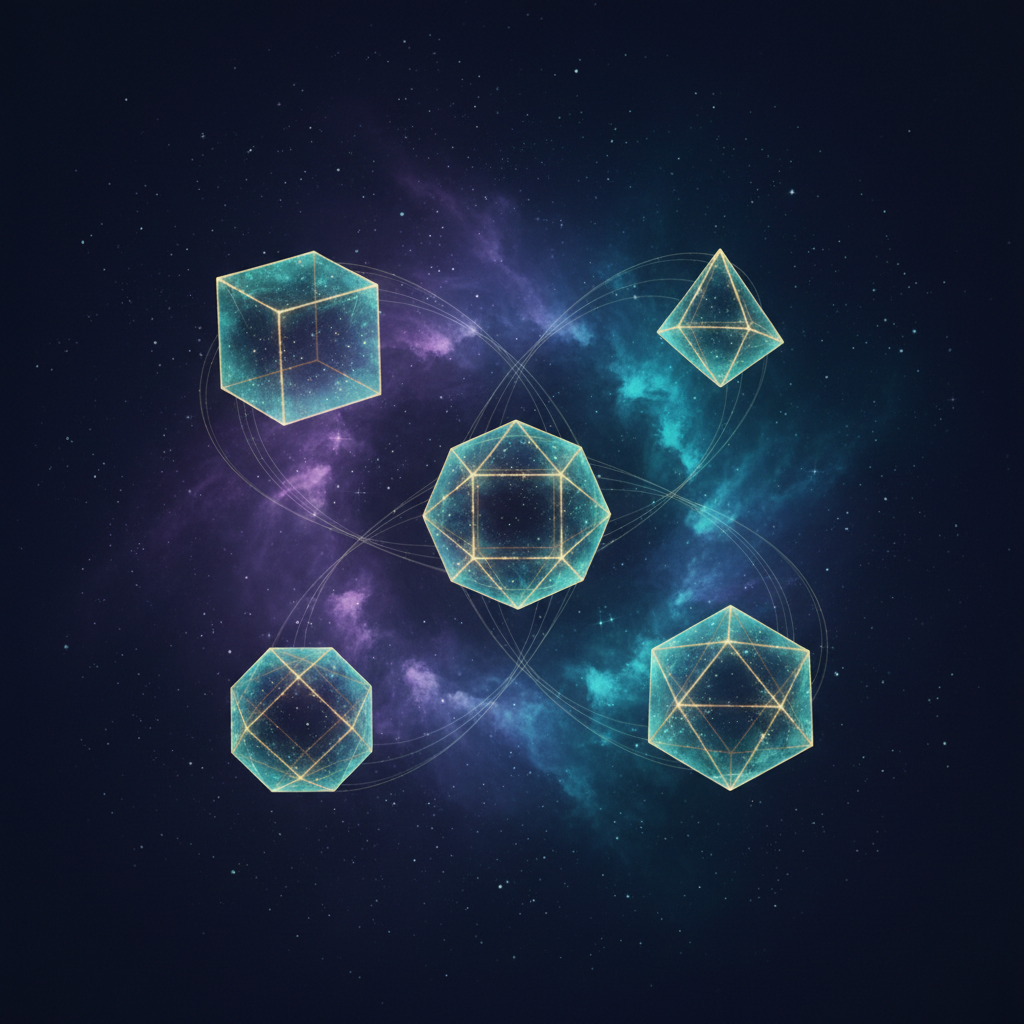
What are these five volumes that the cube holds? They are the only five three-dimensional shapes that can be built from a single kind of regular polygon, meeting at every vertex in the same way — the only five perfect ways to seal surface into volume. The Greek mind noticed this and drew an inevitable conclusion. As Hall puts it: "The Greeks believed the world [material universe] to be composed of four elements — earth, air, fire, water — and to the Greek mind the conclusion was inevitable that the shapes of the particles of correspondence✦ere those of the regular solids."
Plato worked this out in the Timaeus, assigning one solid to each element and a fifth to the enveloping reality beyond them. Schneider's A Beginner's Guide gives the correspondence in clean tabular form, adding the modern physical insight that each "element" corresponds less to a substance than to a state of matter:
| Platonic Solid | "Element" (Plato) | Face Shape | Faces | Corners | Modern Reading |
|---|---|---|---|---|---|
| Tetrahedron | Fire | Triangle | 4 | 4 | Plasma (the "burning" state) |
| Octahedron | Air | Triangle | 8 | 6 | Gas |
| Icosahedron | Water | Triangle | 20 | 12 | Liquid |
| Hexahedron (Cube) | Earth | Square | 6 | 8 | Solid |
| Dodecahedron | Cosmos / Heaven | Pentagon | 12 | 20sun◈The all-encompassing "quintessence" |
Schneider adds a subtlety that bridges the ancient and the modern: "We laugh at the simplicity of the ancient concept of just four 'elements' comprising the world when today we recognize over one hundred varieties of atom. But no matter who looks at the world or when, we can find only four phases of matter, four clothings of nature." The fiery tetrahedron, he notes, is "known today as 'plasma,' the glowing electrified gases that 'burn' in the sun and stars." Ancient element and modern phase diagram turn out to be describing the same fourfold order of nature. The Egyptians had their own concordance, which Schneider also tabulates — associating the tetrahedron with the cat or lion and granite (igneous rock), the octahedron with the hawk and alabaster, the icosahedron with the crocodile and limestone, the cube with the beetle and sandstone. The same five bodies, the same fourfold structure, wearing different cultural garments.
The fifth solid deserves particular attention. The dodecahedron — twelve pentagonal faces — is Plato's "Heaven" and the "quintessence" (literally the fifth being) that encompasses the other four. Lawlor deepens this: in the Hindu vision of the Purusha, the Cosmic Man, the dodecahedron is seen as Prakriti, "the feminine power of creation and manifestation, the Universal Mother, the quintessence of the natural universe" — the one form that touches and contains all the others. Where the four solids of the elements are the building blocks, the dodecahedron is the envelope: the shape of the cosmos as a whole, the container that relates them. It is no accident that the faces of the dodecahedron are pentagons — for the pentagon is where the golden ratio makes its first geometric appearance, and the golden ratio is the thread we have yet to pull.
The Genesis of the Cosmic Volumes
Both Lawlor and Schneider emphasize that these five volumes are not static objects but the culmination of an act of generation. Lawlor's term is striking — the "Genesis of the Cosmic Volumes" — and he treats them as "symbolic condensations of spiritual forces," the endpoint of the entire geometric progression from point to circle to polygon to volume. The construction is exactly as we have described: from the one circle, the vesica and the equilateral triangle; from the triangle, the tetrahedron (fire); from the square, the cube (earth); from the pentagon, the dodecahedron (heaven) — and so on, each volume "born" by giving that specific field of space its minimal regular closure. "Constructing the universe, therefore," in Schneider's phrase, "involves the process of volumization" — the turning of flat pattern into three-dimensional body. This is the deepest meaning of the phrase "the blueprint of creation": reality is not drawn; it is closed into being, surface by surface, until the volumes snap shut.
This is also where sacred geometry becomes, unexpectedly, a physical program rather than a metaphor. Because the human body and the temple are both built from these volumes, the study of the solids is simultaneously the study of the body and the study of architecture. We have arrived at the doorstep of the tradition's central claim: that the same geometry that closes a crystal also closes a spine.
The Microcosm and the Macrocosm: Man as Temple
The man who pushed this claim furthest, and measured it most rigorously, was R. A. Schwaller de Lubicz, whose studies of the Temple of Luxor in The Temple in Man and The Egyptian Miracle are among the most serious attempts ever made to read Egyptian architecture as encoded human physiology. His conclusion is blunt: "The Temple of Luxor was constructed to explain" the correspondence between the human and the cosmic. "The human body," he writes in The Egyptian Miracle, "is the living synthesis of the essential vital functions of the universe. Through its organs and their living functions, it epitomizes all of nature."
Schwaller's method is important because it belongs to the measured, not the fanciful, branch of the tradition. He insisted that the proportions of the temple could not be imposed on it after the fact — no one "thought of this number in establishing this form, any more than a plant would think of it." The Golden Number he sought was "not the product of mathematical imagination but the natural principle of the laws of equilibrium," something that appears of itself wherever structure is stable and pleasing. He and his stepdaughter Lucie Lamy surveyed Luxor stone by stone — Drunvalo was astonished both by the precision of their survey and by the fact that the Fruit of Life appeared in it unmistakenly. The temple, in their reading, is a standing human figure: the sanctuary the head, the hypostyle hall the torso, the approach the legs, with every joint and threshold cut to correspond to the anatomy encoded in the proportions.
The governing ratio of this correspondence is the golden ratio, φ ≈ 1.618, together with its sibling surds √2 and √3. Schwaller analyzed the human figure and found the point of division not at the anatomical middle but at the navel — the golden section of bodily height — a canon that descends, via Vitruvius and Leonardo da Vinci's Vitruvian Man, from the same line of thought Drunvalo traces back to Thoth. Drunvalo, for his part, derives the human levels of consciousness from the circle–square pairings: the fourth square penetrating the fifth circle, and the seventh square the ninth circle, produce the near-perfect φ-ratios that define, on his account, the first (aboriginal), second (present), and third (Christ) levels of human consciousness. Whether or not one accepts the eschatological framing, the underlying observation is defensible: the human form, like the temple, is organized around the same proportions that the vesica, the pentagon, and the Flower of Life encode.
The same harmonic extends to the largest scale. Drunvalo runs the numbers on the Earth and Moon: the Moon's diameter of 2,160 miles added to the Earth's 7,920 gives 10,080 miles — and 10,080 × π (using 22/7) yields 31,680 miles, exactly the perimeter of the square that circumscribes the Earth. Earth and Moon, he concludes, stand in a φ-ratio to one another, and that ratio "is found in the proportions of our human energy fields and even in the very Egg of Life itself." Whether one takes this as evidence of cosmic design or of the human mind's compulsion to find ratios in anything, it demonstrates how the tradition fuses the microcosm (the body) and the macrocosm (the planets) into a single canvas ruled by one set of proportions.
Geometry, Harmony, and the Science of Implosion
If Schwaller represents the measured pole of the tradition, then Dan Winter represents the energetic pole — and his work is worth understanding on its own terms as the tradition's speculative frontier. Winter's Alphabet of the H)Eart(H and The Secret Science of Ecstasy and Immortality read the Platonic solids, and above all the dodecahedron, as the template of physiological coherence. He speaks of architecture as "frozen musical emotion in stone," and of the dodecahedron's faces linking "the entire alphabet of polyhedral geometry to an infinite nest of phase-locked faces" — joining the twelve-faced zodiac, the "ratcheting dodeca" of DNA, the Merkabah, and the "City of Revelation" into one continuous geometry.
Winter's distinctive move is the concept of implosion. Where explosive combustion drives energy outward and away, the geometry of the golden ratio, he argues, supports implosive collapse — energy folding inward and back upon itself, which he associates with coherence, ecstasy, and longevity. The heart, on this view, is not a pump but a toroidal vortex whose field is sustained by the very phase-locking the dodecahedron represents. This is speculative science, on the outer edge of the corpus, and it should be read as such — but it is a historically coherent speculation, continuous with an old idea that the Pythagoreans and the temple-builders shared: that harmony is not a poetic accident but a physical ordering principle.
There is a resonant echo between this and the modern physics that sits, surprisingly, inside the same corpus. The Holographic Universe (Michael Talbot) and the essays on the amplituhedron and the positive Grassmannian that appear among the archives describe an emerging picture in which "the universe itself is organized" nonlocally, its geometry encoding its content. David Bohm's holographic model, and the recent discovery that scattering amplitudes can be reduced to a single geometric object, both resonate with the tradition's oldest claim: form precedes content; the pattern is the physics. When an ancient priest drew the Flower of Life, and a modern physicist draws the amplituhedron, they are reaching toward the same intuition from opposite ends of history.
Numbers in Nature
One further observation grounds all of this in the visible world. The golden ratio and the Platonic solids are not confined to temples and treatises; they are the recurring vocabulary of biology. The spiral of a nautilus shell, the seed-head of a sunflower, the counter-rotating coils of DNA, the branching of ferns and the phyllotaxis of leaves — all exhibit the same φ-rhythms and the same fivefold and sixfold symmetries the geometry describes. The Origins of Sacred Geometry and Schneider's survey both make the point that "sacred geometry" is, at bottom, nature's own geometry, the mathematical archetypes that living tissue actually uses. The tradition's claim is not that humans invented these shapes and projected them onto nature; it is that humans recognized shapes nature had already been using all along, and then built temples and meditations that re-create them on purpose. Science and sacred geometry, at this level, are not enemies. They are two dialects of a single investigation: what is the structure that form obeys?
Building a Practice: Geometry as Meditation
The cross-tradition records that tie geometry to the whole esoteric map are immense — explore the Library of Alexandria for the deeper treatises on number, proportion, and the cosmic plan.
Sacred geometry is not, finally, a body of facts to be memorized but a discipline to be performed. Every tradition we have drawn from — the Kabbalist meditating on the connecting lines of the alphabet, the Egyptian initiate walking the measured halls of Luxor, the Pythagorean contemplating the Tetraktys, the neo-Platonist turning the Platonic solids in the mind — treats the geometry as an operation to be done, a way of training attention and attuning the perceiver to pattern. Schneider's whole book is organized this way: constructing the universe, with compass and straightedge, is the practice, not just reading about it.
A serious study practice, grounded in what the archives actually teach, can be built in four steps:
-
Draw. Acquire a compass and straightedge and physically reproduce the sequence — one circle, the vesica, the equilateral triangle, the Seed of Life, the Flower, the Fruit, Metatron's Cube. Construction through the hand fixes the relations in the body, not merely the intellect. This is what both Schneider and Lawlor emphasize: the discipline is constructive, and the construction is the meditation.
-
Build the solids. Move from two to three dimensions. Draw the nets of the five Platonic solids on paper and fold them into paper models; better, cut the five solids from wood or plastic and hold them. Feel the difference between the fire tetrchakra◈n and the earth cube in the hand. Notice how the dodecahedron relates to its neighbors as the "enfolding" form.
-
Measure the body. Study the canon of proportions — the golden section at the navel, the root-two and root-three relations of the limbs — against your own body, as Vitruvius, Leonardo, and Schwaller did. Use the circle-and-square scheme Drunvalo derives to understand the ratios as living structure rather than academic data.
-
Meditate on form. Contemplate one figure at a time — trace the Flower of Life with the breath, hold the dodecahedron or the golden spiral in the mind's eye, visualize the Merkabah (the star-tetrahedron light body Drunvalo develops through his 13-chakra system) rotating around the spine. The goal, as the tradition frames it, is to quiet the analytical, naming mind and let the pattern itself become the content of awareness.
Sustained practice of this kind tends to change how one sees the world — not because the symbols are "magical," but because the perceiver becomes fluent in a grammar that the world is already speaking. Mandalas, cathedral floor plans, the spirals of weather and galaxy, the counter-rotation of DNA: once the eye can construct them, it cannot un-see them. The study becomes a lifelong conversation with structure itself.
The Archives: Studying Deeper
This essay has moved from a single circle to the five solids of the cosmos, and from an Egyptian temple to the cells of the human body — a journey the tradition insists is one journey. But an essay can only gesture; the real work requires the source material. Everything here is drawn from a real, studyable corpus, and the difference between knowing the names of these figures and being able to construct and work with them is exactly the difference between a summary and the archives.
The primary text is Drunvalo Melchizedek's The Ancient Secret of the Flower of Life, in both its volumes — the deepest popular exposition of the Flower, the Fruit, the Merkabah, and the Egyptian temple geometry, with hundreds of diagrams to work through by hand. Alongside it, Michael S. Schneider's A Beginner's Guide to Constructing the Universe and Robert Lawlor's Sacred Geometry: Philosophy and Practice provide the cleanest step-by-step constructions, while R. A. Schwaller de Lubicz's The Temple in Man and The Egyptian Miracle supply the rigorous, measured reading of Luxor as encoded human form. For the harmonics and the speculative frontier, Dan Winter's Alphabet of the H)Eart(H and The Secret Science of Ecstasy and Immortality explore the implosive, coherent side of the doctrine; and the Sefer Yetzirah in Aryeh Kaplan's translation anchors the Kabbalistic practice of letter-and-line meditation.
These are exactly the kind of reference works a serious sacred-geometry archive should hold. The sacred-geometry archives gathered below bundle precisely this: complete collections of diagrams, studies, and construction references you keep for life — so that you are never reduced to a remembered name, but can always return to the measured source and build the figure yourself. If the Flower of Life and Metatron's Cube have ever pulled at you, that is the place to begin: at the beginning, with one circle, and the patience to draw what follows.
Explore Related Scrolls
Metatron's Cube and the Tree of Life: When Kabbalah and Geometry Share One Blueprint
sacred-geometry
The Entheogenic Dream: DMT, REM, and the Shared Architecture of Visionary Worlds
entheogens
As Above, So Below: The Secret Thread Running Through the Western Mysteries
gnosticism
How to Read the Tarot: A Beginner's Map of the 78 Cards
tarot
Continue the Inquiry
✦ Discuss this in the Agora →Join seekers in the Vault's forum — human + AI dialogue on this tradition
✦ Continue This Inquiry ✦
This inquiry doesn't have to end here. Bring your questions, reflections, or practice to the Oracle — and continue in dialogue.
Stay attuned — subscribe to The Transmission
✦ FURTHER TRANSMISSIONS ✦
Enjoyed this transmission? Subscribe for more from the threshold.
Want to go deeper with others? Discuss this essay in the Agora →
Deepen this study
Shop the Archives
Continue the thread with the primary source vaults behind the Scroll.
Sacred Geometry Master Collection | 639 Files | EPS AI SVG Png Jpg | Mandalas, Symbols & Golden Mean | Digital Download
$12.99 · View →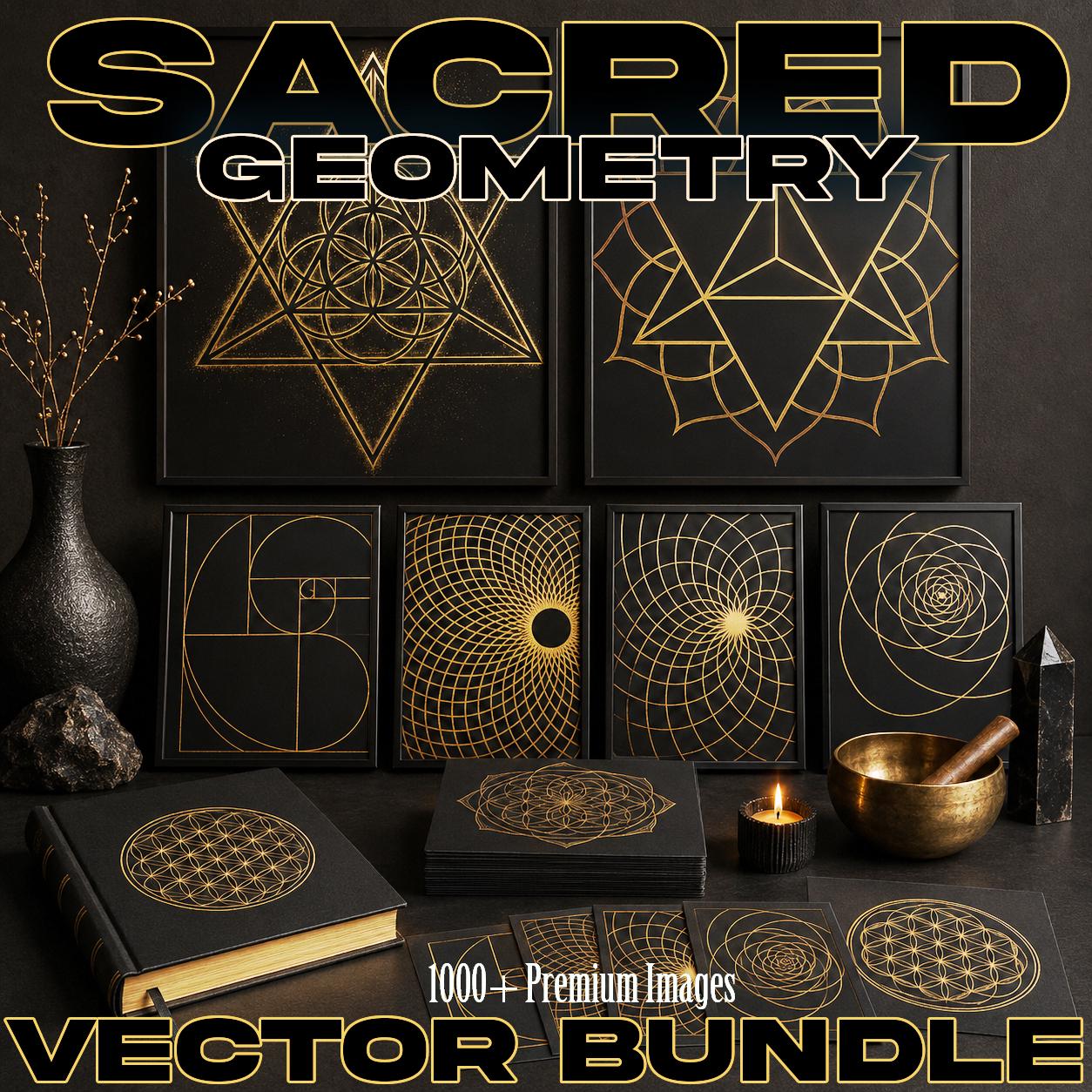
Sacred Geometry Vector Bundle – 1000+ .ai .eps .svg .psd .png, Mandalas, Chakras, Golden Ratio & Esoteric Symbols
$17.77 · View →
The Library of Alexandria – Ultimate Esoteric Digital Archive (123GB, 23,000+ eBooks on Alchemy, Magick, UFOs, Tantra, Gnosticism & More
$99.99 · View →✦ FURTHER TRANSMISSIONS ✦
Enjoyed this transmission? Subscribe for more from the threshold.