Tantra and Kabbalah: The Tree of Life and the Body of Light — Two Maps of the Inner Cosmos
Limited archive sale · 20% off every pack
20% Archive Sale
Deepen this scroll with the primary-source archive packs behind the Vault: grimoires, oracle systems, alchemy, tarot, sacred geometry, and manifestation libraries.
Tantra and Kabbalah: Two Maps of the Inner Cosmos
Layer 1: The Human Anchor
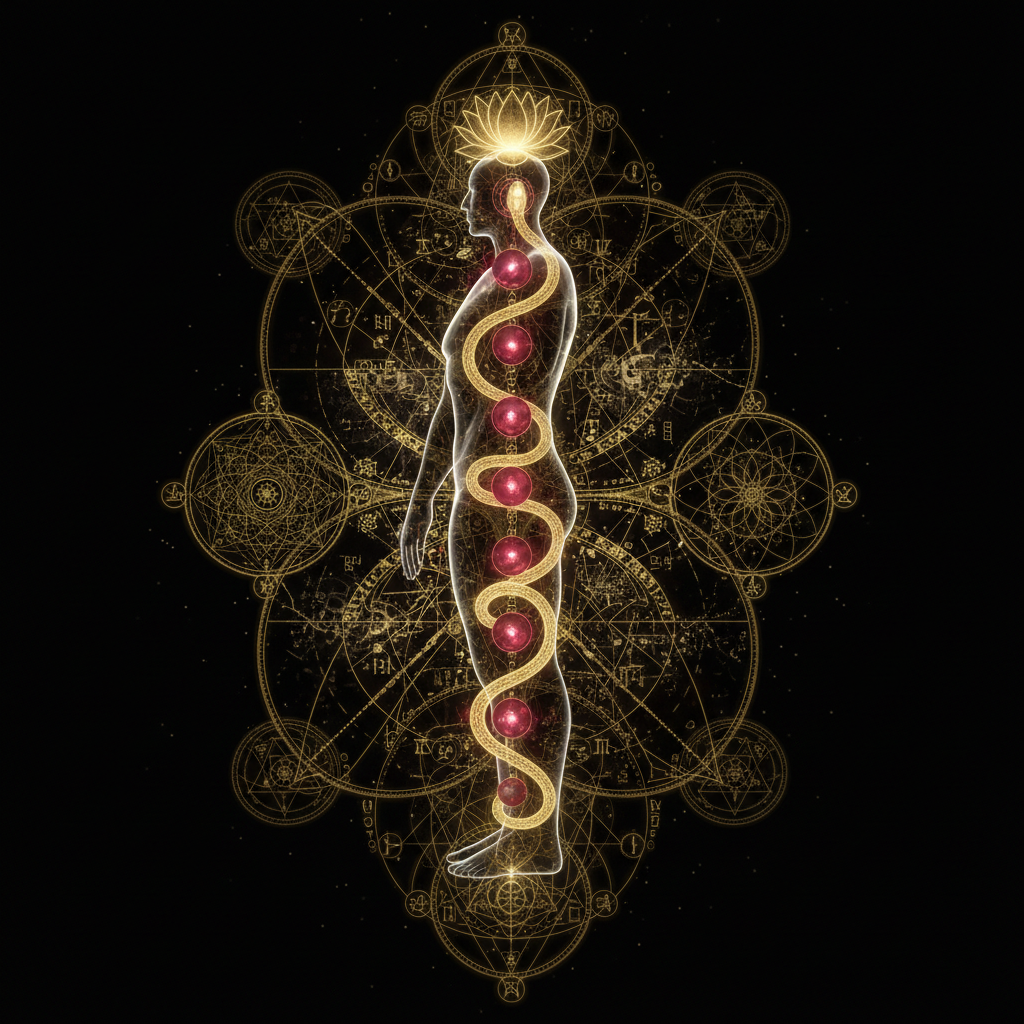
There is an old and stubborn teaching, found in nearly every genuine esoteric system, that the human body is not a container we inhabit but a map we are meant to learn to read. The Tantric lineages of India and the Kabbalists of the West both built their entire architecture on this single conviction: that the whole of the cosmos is written into the upright human form, and that the way◈ to know the cosmos is to turn the gaze inward and climb. Work through the combined Kundalini and Tree of Life archive here and the correspondence✦ becomes obvious at a glance — the chakra column of yoga and the ten sefirot of Kabbalah are two versions of the same ascensional map, one drawn from the base of the spine to the crown, the other from the lowest world to the Ein Sof. This essay is an attempt to hold both maps up side by side and show that, beneath their very different languages, they describe one journey.
I. The Body as Ladder and Microcosm
Begin with the premise both traditions share, because it is the ground on which everything else is built. The Tantric view of the body is radically different from the modern one. It does not regard the physical form as a temporary prison from which the soul must escape; nor does the mature Tantric path treat the world as illusion to be fled. Rather, the body is understood as a condensed universe — a microcosm in which the same forces that structure the galaxies also structure the nerves. The Kularnava Tantra, one of the most revered of the Tantric texts, is explicit that liberation is not found by abandoning the body but by knowing its inner geography, because the divine does not sit above the world but is built into it and into us. This is the doctrine that later Western readers would recognize as "as above, so below," arrived at independently on the banks of the Ganges.
The Kabbalah reaches the same axiom by its own path. The central figure of Kabbalistic anthropology is Adam Kadmon, the Primordial Man — not a historical ancestor but the original shape of creation itself, the first vessel in which the divine light was configured. Everything that exists, the Kabbalists teach, is arranged inside the pattern of this cosmic human, and the human being in front of us is a miniature of that pattern. The ten sefirot, the ten emanations through which the Ein Sof — the Infinite — unfolds into the world, are traditionally mapped onto the parts of the human body: Kether (the Crown) above the head, Chokhmah and Binah (Wisdom and Understanding) in the brain, Chesed and Gevurah (Mercy and Severity) in the two arms, Tiferet (Beauty) in the heart, and the lower sefirot from the pelvis down to Malkuth, the Kingdom, at the feet. The Sefer Yetzirah, the oldest surviving text of the tradition — kept in the corpus in Aryeh Kaplan's annotated edition alongside Isaac the Blind's medieval commentary — calls the ten sefirot the ten fingers and the ten utterances, tying the very structure of the hands and speech to the structure of reality. In both systems the answer to the question "where is the Divine?" is the same: inside the shape of a person.
What follows from this is a discipline rather than a theology. If the body is a map, then the work is to travel it, and both traditions insist that the journey is made by stages that correspond to definite inner landmarks. The map is not symbolic decoration; it is an itinerary.
II. The Landscape: Seven Stations and Ten Emanations
The Tantric map is the column of the chakras◈ — the subtle energy-centers arranged along the spine, connected by the three great channels, or nadis: ida on the left, pingala on the right, and the central sushumna, the axis of awakening. The classical system, as set down in full in Sir John Woodroffe's The Serpent Power◈ — The Secrets of Tantric and Shaktic Yoga, the foundational manual that opens the Tantra source-texts collection, describes the serpent-power Kundalini coiled at the base of the spine in the root center (muladhara◈) and its progressive awakening as it rises through the centers — the sacral (svadhisthana◈), the solar plexus (manipura◈), the heart (anahata◈), the throat (vishuddha◈), the brow or third eye◈ (ajna) — until it reaches the thousand-petaled lotus at the crown (sahasrara◈). At each center the rising consciousness takes on a distinct quality, and the tradition is careful to say that these are not mere symbols but real, felt shifts in awareness.
The Kabbalistic map is the Etz Chaim, the Tree of Life: ten sefirot arranged in three columns — the pillar of Mercy on the right, the pillar of Severity on the left, and the central pillar of Equilibrium — connected by twenty-two paths corresponding to the twenty-two letters of the Hebrew alphabet. The sefirot descend from Kether, the Crown (the first emanation and the closest the finite can approach the Infinite), through the supernal triad and the heart of the Tree, down to Yesod (Foundation) and finally Malkuth, the Kingdom, which is the world of ordinary experience. The Zohar, the great compendium of Kabbalistic exegesis, presents this descent not as a static diagram but as a living flow of light — the "lightning flash" (kav) that arcs from the Infinite down through each sefirah, dividing and refracting as it descends.
Set the two landscapes side by side and the correspondence is structural rather than exact. Neither tradition is a perfect one-to-one mirror of the other; each has its own emphasis and its own number. But the shape of the two maps is unmistakably the same: a vertical axis of ascending consciousness, marked by distinct stations, rising from the base of the body to a point above the crown where the individual meets the Infinite. The table below sets them side by side, not to force a strict identity where none exists, but to show how consistently the two traditions converge on the same architecture.
| Tantric Chakra | Region | Kabbalistic Sefirah | Shared Station |
|---|---|---|---|
| Muladhara — root | base of spine, foundation of earth | Malkuth — Kingdom | the ground of embodiment, where ascent begins |
| Svadhisthana — sacral | pelvis, water, the life-force | Yesod — Foundation | the seat of generation and the root of desire |
| Manipura — solar plexus | fire, will, the transmutation of fear | Hod & Netzach — Splendour & Victory | the field of drive, vital energy and striving |
| Anahata — heart | air, the balance of love and power | Tiferet — Beauty | the central point, the reconciling heart |
| Vishuddha — throat | ether, sound, the voiced truth | Chesed & Gevurah — Mercy & Severity | the utterance of judgement and grace |
| Ajna — third eye | the brow, seeing beyond the veil | Chokhmah & Binah — Wisdom & Understanding | the gate of insight above the heart |
| Sahasrara — crown | the thousand-petaled infinity | Kether — Crown (and beyond, the Ein Sof) | the meeting of the individual with the Infinite |
The point of such a table is orientation, not taxonomy. A student who reads it as a claim that the traditions are secretly identical has missed the lesson; a student who refuses to see the correspondence has missed the architecture. What matters is the shared direction of travel — up the center of the body, through the stations, toward the crown — and the shared insistence that this vertical ascent is the path that leads out of suffering and into realization.
III. The Descent of the Light and the Ascent of the Fire
Here the two traditions show their subtle difference, and it is a productive one. The Kabbalah is, at its root, a science of descent: the Ein Sof contracts (tzimtzum), withdraws to make room for creation, and then rays of light (kav) stream downward through the sefirot, successively veiled at each stage, until they reach the broken vessels of the material world. In the cosmology of Isaac Luria — the great sixteenth-century master of Safed, whose teachings the corpus preserves in Apples from the Orchard, the collected mystical writings of the Arizal — the process involves a catastrophe and a repair: the vessels meant to contain the divine light shatter (shevirat ha-kelim), scattering sparks of holiness into the lowest places, and the whole of human spiritual labor becomes tikkun, the gathering-up and restoration of those scattered sparks. The Kabbalist's task is to reverse the descent, to climb back up the Tree the light came down, and in so doing to heal the rupture in creation itself.
The Tantra, by contrast, is a science of ascent driven by fire. The Kundalini is not God descending to us; it is the power already asleep at the base of the spine, and the work is to awaken and lift it. The Vijnana Bhairava Tantra, a text of the highest importance in the Kashmir Shaivite school, preserves over a hundred meditative techniques (dharana) for this awakening — practices of breath, gaze, and absorption that begin in the ordinary mind and carry it up through the centers. In the philosophy of Abhinavagupta, the greatest philosopher of Kashmir Shaivism — read in the corpus through Jaideva Singh's Siva Sutras and his Trident of Wisdom commentary on the Vijnana Bhairava — this ascent is understood through the doctrine of pratyabhijna, "recognition": the goal is not to attain something new but to recognize that the individual consciousness (jiva) is not separate from the universal consciousness (Shiva), and that the whole journey up the spine is the consciousness coming to recognize itself. The fire of Kundalini is Shakti rousing Shiva from the stillness of the crown; the two poles reunite.
These are not contradictions but the two halves of a single circle. The Kabbalah charts the descent and asks us to reverse it; the Tantra charts the ascent and asks us to complete it. Both are describing the same axis from opposite ends — one from the Infinite's perspective, watching the light fall and seeking to rise again to meet it; the other from the embodied soul's perspective, feeling the fire rise to meet the stillness above. The practitioner in either tradition finds themselves on the same ladder, climbing from the base to the crown, and both traditions agree that the climb is the meaning.
IV. Shakti and the Shekhinah: The Feminine Power at the Hinge
If any single convergence marks these two traditions as cousins, it is the place they both give to the feminine divine. In the Tantra this is everywhere: the ultimate reality is not a solitary male principle but the union of Shiva — pure, unchanging consciousness — and Shakti — its dynamic, manifesting power. Nothing exists without Shakti; she is the energy, the movement, the world-body of the divine. In Kashmir Shaivism the supreme is often named as the union of the two, and in the Sri Vidya tradition — the worship of the goddess in the form of the Sri Chakra — the feminine principle herself becomes the object of the whole ascent. Arthur Avalon's Shakti and Shakta and Jan Fries's Kali Kaula open the goddess layer of the Tantra corpus and make plain how thoroughly the tradition centers on her. The rising of Kundalini is literally the awakening of Shakti, and her final resting is her union with Shiva in the thousand-petaled crown: the return of the power to its source.
The Kabbalah has a precise and haunting parallel in the Shekhinah, the indwelling presence of the Divine. In the classical texts the Shekhinah is the feminine aspect of divinity, the presence that dwells among creation and, in exile, is separated from the masculine principle above. The Zohar — assembled in the corpus from the core Zoharic texts, the Sifra Detzniyutha, and the Bahir — returns again and again to this theme of separation and reunion: the divine is, in a sense, fractured by the exile of the Shekhinah, and the whole of Jewish spiritual practice is understood as the work of reuniting the Shekhinah with her source — the Tiferet — restoring the marriage of the upper and lower worlds. The final sefirah, Malkuth, is itself identified with the Shekhinah: the Kingdom is the feminine presence at the bottom of the Tree, and the ascent of the mystic is in part the lifting-up of the indwelling presence to her home above.
Put the two figures beside each other and the convergence is striking. Both traditions place at the hinge of the spiritual journey a feminine divine power that is separated from its source by descent into matter, and both frame the goal of practice as the reunion of that feminine power with the masculine principle above. In the Tantra the Shakti rises to meet Shiva; in the Kabbalah the Shekhinah is lifted to meet Tiferet. The genders of the union are the same, the estrangement is the same, and the reconciliation is the same. It is one of the deepest and least remarked-over agreements between the Indian and the Western esoteric worlds — a shared intuition that the peak of the path is not a state of sterile oneness but a marriage.
V. The Yantra and the Tree
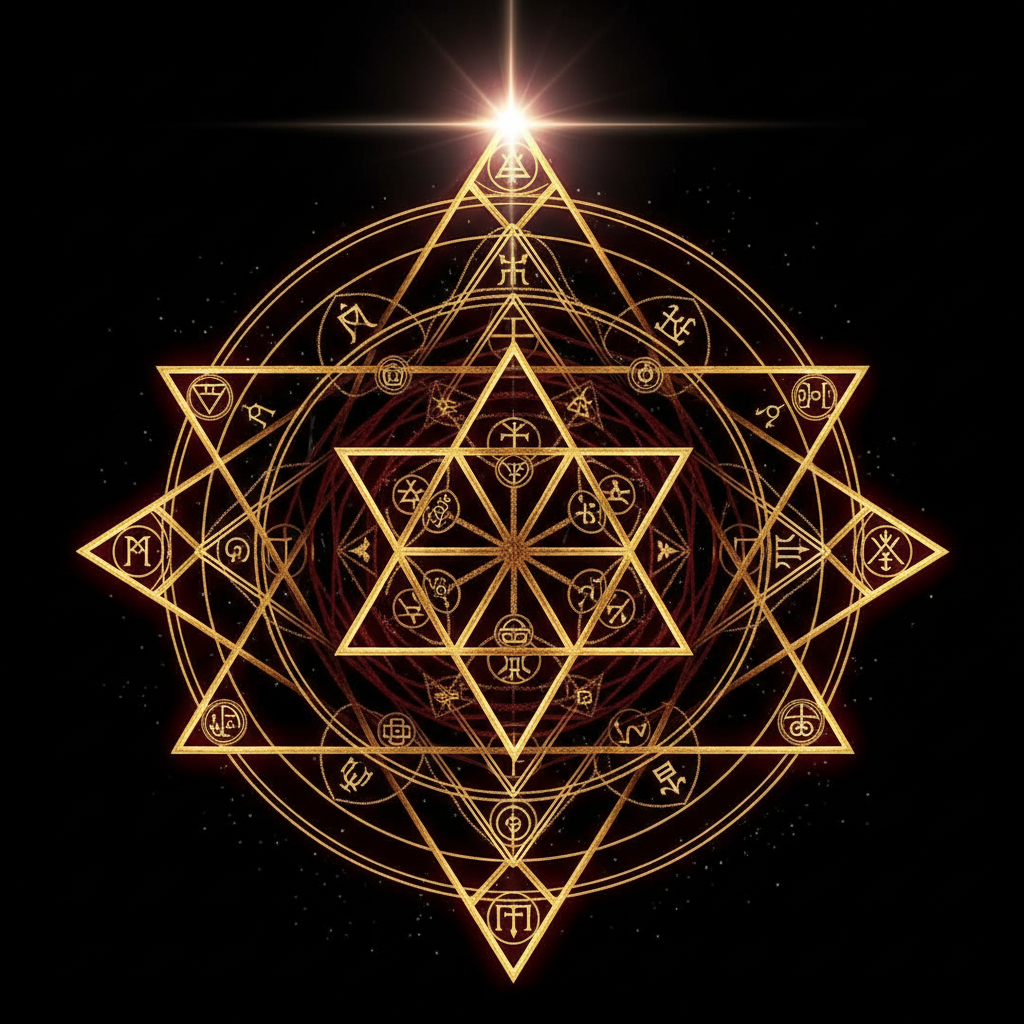
The two traditions also agree that these maps are not confined to the body but are inscribed in geometric form — and here the resemblance becomes almost visible. The central geometric symbol of the Tantric tradition, especially of Sri Vidya, is the Sri Chakra (also called the Shri Yantra): a configuration of nine interlocking triangles — four pointing upward, representing Shiva, and five pointing downward, representing Shakti — arranged around a central point (bindu), creating forty-three smaller triangles in perfect concentric rings. The Sri Chakra is simultaneously a map of the cosmos, a map of the body, and an object of meditation: to contemplate it correctly is to trace the whole descent and ascent of consciousness in a single, symmetrical figure.
The Kabbalistic Tree of Life is, in its way, an equally precise geometric mandala: ten sefirot and twenty-two paths arranged so that the whole of reality is expressed in one diagram. The Tree and the Sri Chakra share a formal logic — a central vertical axis, a symmetrical arrangement of emanations, and a single source and point of return — and practitioners of both traditions have noted that the bindu, the central point of the Sri Chakra, and Kether, the Crown of the Tree, occupy the same functional position: the point where the differentiated many collapses back into the undifferentiated One. The sacred-geometry current that runs through both traditions — the conviction that reality is structured by number and proportion and that meditation on those structures is itself a form of practice — is one more symptom of the same underlying vision.
That vision is worth stating plainly, because it is the deepest claim of both traditions: the map is not secondary to the territory; the map is a more complete version of the territory. The body is a tree; the tree is a man; the yantra is a cosmos; the cosmos is a body — and the mind that can hold all these identities together at once has begun to see the way the traditions see.
VI. The Daily Work: Breath upon the Axis
Neither tradition is content to remain a map to be admired; both insist that the map must be walked, and both offer daily practices for doing so. On the Tantric side the central instrument is pranayama — the regulation of the breath that moves energy along the axis of the spine. The Hatha Yoga Pradipika is emphatic that the two side-channels, ida and pingala, are governed by the two nostrils and that the practice of alternate-nostril breathing steadies the mind and draws the current into the central sushumna. The technique is deceptively simple and its aim is enormous: to draw the wandering life-force into the central column where the ascent can occur. On the Kabbalistic side the daily instrument is contemplation of the sefirot combined with the intention of devekut, "cleaving" — the focused attachment of the mind to the divine through the structure of the Tree, so that one's thought, speech, and deed are aligned with the flow of emanation. Rabbi Moshe Cordovero's Tomer Devorah — The Palm Tree of Deborah, one of the most studied works in the Lurianic collection, systematized the daily alignment of each limb and quality with a sefirah as a discipline of the meditative life, and Lawrence Fine's study of the contemplative techniques of Isaac Luria and Hayyim Vital carries that practice deep into the interior ascent.
The two practices converge on a shared test, and it is the truest index of whether the teaching has taken: stability that is not rigidity. The practitioner of pranayama who has truly steadied the current stops being thrown by circumstance, because the energy no longer leaks through the wandering side-channels; the practitioner of devekut who has truly cleaved stops being ruled by reaction, because the mind is anchored to the source. What is produced is not a clenched control but a luminous composure — the poised stillness that the Tantra calls siddhi and the Kabbalah associates with the central, reconciling sefirah of Tiferet. This is the point where both traditions stop describing the cosmos and start producing a kind of person, and it is the only proof either tradition ultimately accepts.
To walk both maps at once is to hold a double discipline: to feel the fire of Kundalini rising through the body's seven stations, and simultaneously to see the light of the Ein Sof descending and re-ascending through the Tree's ten emanations; to work with the breath of the right and left channels, and with the two pillars of Mercy and Severity, until both resolve in the center. The body becomes a living axis, and the practitioner becomes, in the oldest sense of the word, a microcosm — a small universe in which the great ascent is enacted daily.
VII. The Open Inquiry — Enter the Vault
None of this is meant to collapse one tradition into the other. The differences are real and a serious student keeps them: the Tantra meets divinity as fire and feminine power within the living body, while the Kabbalah meets divinity as light and infinite withdrawal mediated by the letters; the Tantra's map has seven stations where the Kabbalah's has ten, and each tradition carries its own history, its own covenant, its own people. Yet when the two are set beside one another, the shared architecture becomes undeniable — a vertical axis, a feminine power at the hinge, a descent and an ascent, and the body as the ladder. Held together they do what each alone cannot: the Tantra gives the Kabbalist the somatic fire and the felt inner geography, and the Kabbalah gives the Tantric the vast cosmic frame and the discipline of the divine letters. Study the full Kundalini and Tree of Life master archive, with its Tantra and Chakra depth, here, and let the sefirot and the Zohar speak directly through the Kabbalah Oracle here. The snake is coiled at the base of the Tree, waiting to climb. The ladder is rooted in the body, waiting to be walked.
Explore Related Scrolls
Metatron's Cube and the Tree of Life: When Kabbalah and Geometry Share One Blueprint
sacred-geometry
The Entheogenic Dream: DMT, REM, and the Shared Architecture of Visionary Worlds
entheogens
As Above, So Below: The Secret Thread Running Through the Western Mysteries
gnosticism
How to Read the Tarot: A Beginner's Map of the 78 Cards
tarot
Continue the Inquiry
✦ Discuss this in the Agora →Join seekers in the Vault's forum — human + AI dialogue on this tradition
✦ Continue This Inquiry ✦
This inquiry doesn't have to end here. Bring your questions, reflections, or practice to the Oracle — and continue in dialogue.
Stay attuned — subscribe to The Transmission
✦ FURTHER TRANSMISSIONS ✦
Enjoyed this transmission? Subscribe for more from the threshold.
Want to go deeper with others? Discuss this essay in the Agora →
Deepen this study · 20% archive sale
Shop the Archives
Continue the thread with the primary source vaults behind the Scroll.
Kundalini & Tree of Life Master Archive | 277 Files | Tantra, Chakra, Kabbalah / Meditation Study | Digital Download
$9.59$11.99· View →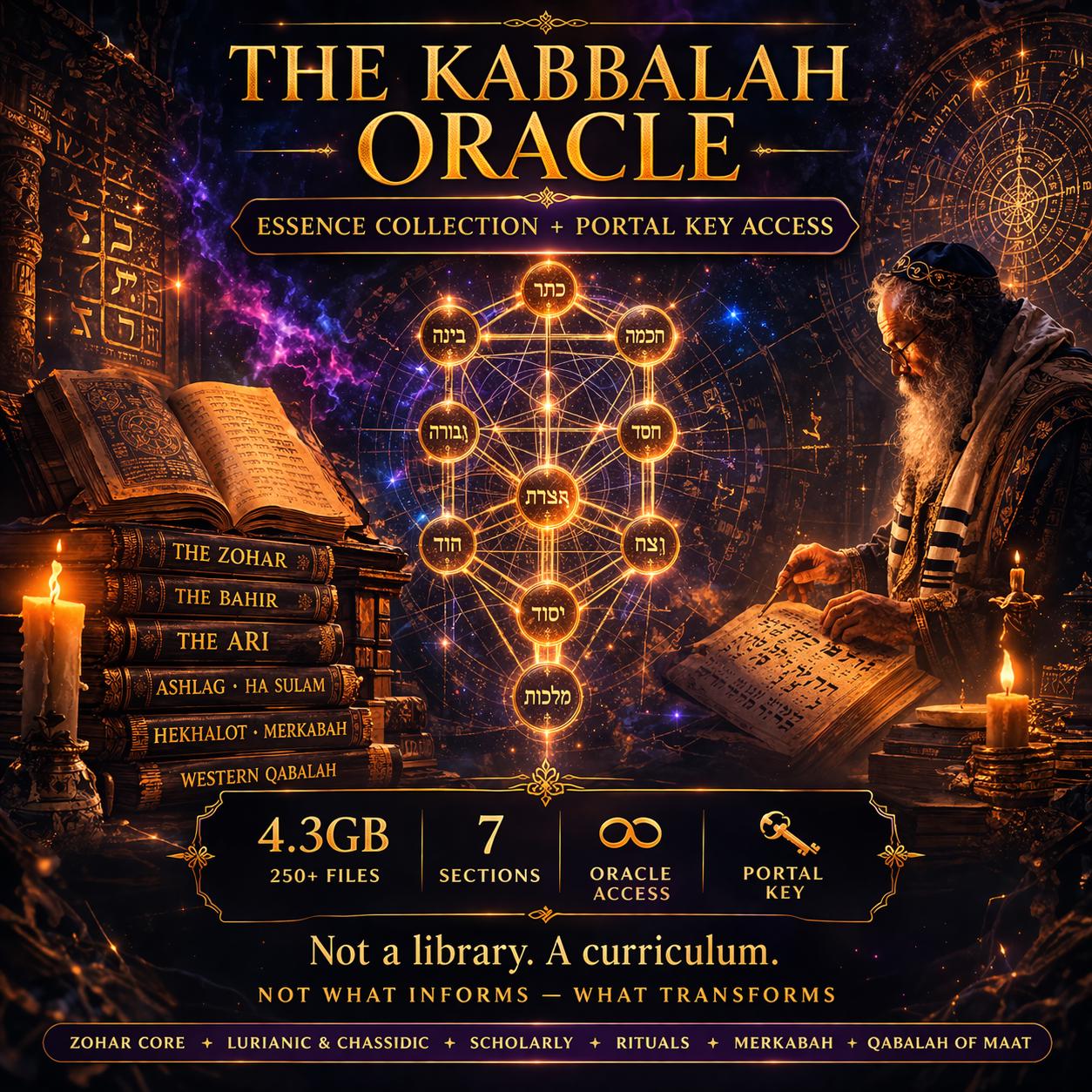
Kabbalah Oracle AI + 4.3GB Sacred Archive | Zohar, Tree of Life, Sephiroth, Gematria, Hermetic Qabalah, Mysticism, Esoteric Knowledge
$7.99$9.99· View →
Kabbalah (Qabalah) Archive 22GB | 750+ eBooks & Manscripts, Texts + 125h Video Courses + Audio Meditations | Rare Occult Esoteric Library
$31.99$39.99· View →✦ FURTHER TRANSMISSIONS ✦
Enjoyed this transmission? Subscribe for more from the threshold.